
February 10, 2026
•5 min read
•By Ir. Bryan Tan, CEng
Same-day slots in Kuala Lumpur & Selangor · Google rating · Licensed contractor · Hours 9:00–22:00
Repeatedly tripping the circuit breaker can permanently damage the outdoor inverter PCB. Here is how to diagnose communication errors versus genuine compressor stall locks.
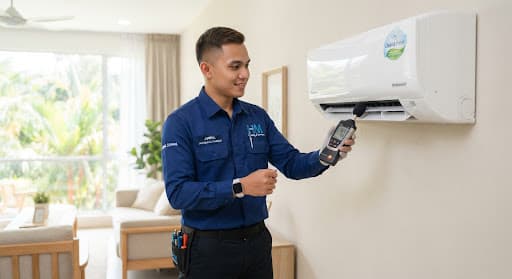
Outdoor inverter PCB faults are confirmed with meters, not by cycling the MCB.
Communication errors and compressor stall locks require different next steps.
When a Daikin, Panasonic, or Mitsubishi indoor unit starts blinking, the instinct in many Klang Valley homes is to trip the miniature circuit breaker, wait ten seconds, and restore power. That reset can clear a latching fault long enough for the compressor to attempt another hard start—exactly when the outdoor inverter module is already overheating or shorted.
Inverter boards interpret sensor data, compressor current, and indoor-outdoor communication. A communication error is not the same as a locked rotor. Treating every blink as a reboot request is how a RM 79 diagnosis becomes a full outdoor PCB replacement.
The MCB is a safety device, not a software reset. If the outdoor inverter has already flagged overcurrent, a forced restart slams DC bus voltage back into a stressed IGBT module. Repeated cycles cook the board, melt driver transistors, and can take the compressor windings with them.
Photograph the indoor LED pulse pattern, leave the isolator off if you smell burning electronics, and wait for a technician. Do not hold the reset button through three or four failed starts.
E6-class indoor codes typically mean the indoor controller cannot handshake with the outdoor inverter. Causes include a nicked interconnect cable, a wet terminal block after a leak, or a failed outdoor communication chip—not a dirty filter.
H6 and similar fan-feedback codes often point to a stalled indoor blower, a failed Hall sensor, or a seized cross-flow fan after lint cake. Resetting power will not free a locked rotor; it only retries the same failed start.
Brand-specific blink counts differ. Count long and short pulses before calling. Bring that count, the model sticker, and whether the outdoor fan spun at all.
HM Cooling isolates the fault before any board is quoted. The sequence is electrical first, mechanical second, then communication.
Confirm isolator state, MCB rating, burnt smell, and whether the outdoor fan or compressor attempted to start.
Check indoor-outdoor interconnect continuity, DC bus voltage, and sensor thermistor values against the service chart.
Only then quote a PCB, fan motor, or refrigerant recovery. No universal aftermarket boards on inverter systems.
These are field patterns, not a substitute for the manufacturer chart on your exact model. They tell you which booking to make.
| What you see | Likely cause | Next step |
|---|---|---|
| Indoor blinks, outdoor dead silent | Lost communication or no outdoor power | Troubleshooting |
| Outdoor fan spins, compressor clicks off | Overcurrent, locked rotor, or PCB driver fault | Do not reset MCB |
| Indoor rattles then H6 / fan code | Blower Hall sensor or seized drum | Part replacement path |
| Code returns immediately after reset | Hard fault still present | Book diagnosis |
If any of the following is true, stop cycling power and request a diagnostic visit. Wall-mounted assessment starts from RM 79.
A phone video of the LED pulse is more useful than a verbal "it keeps blinking."
A caramel or electrical odour from the outdoor unit is a board-level event, not a filter issue.
Genuine inverter PCBs are quoted after confirmation. We do not swap boards to "see if it helps."
An engineering perspective on biofilm accumulation, microbial degradation, and the thermal efficiency penalty of deferred coil cleaning in equatorial Southeast Asia.
More gas does not mean colder air. Excessive hydrostatic pressure causes liquid slugging in the scroll compressor chamber, tripping thermal overload protectors.
Why ground-floor properties face higher coil bio-fouling from lawn fertilizers and garden soils, while high-rises suffer condenser wind-tunnel thermal resistance.
Book a troubleshooting visit. We isolate communication faults, compressor stalls, and sensor errors before recommending any part.
Prompt appointments Monday through Sunday · Diagnosis before replacement